Industrial Design for Handheld Searchlight Housing
Industrial Design for Handheld Spotlight Enclosures: Structure-First Injection Moulded Enclosure Solutions (for OEM Mass Production)
The core of this industrial design for handheld spotlight enclosures lies not in ‘creating an aesthetically pleasing shell’, but in unifying the lamp head style, structural integrity, protective capabilities, and injection moulding production efficiency within a single engineering framework. For procurement and engineering teams, project success hinges on: rational part separation, seamless assembly, controllable moulding, and verifiable outdoor reliability. Thus we prioritise structural integrity, DFM manufacturability reviews, and upfront mass-production risk mitigation over post-production styling fixes.Product Overview: A Tool Housing System Combining Durability, Manufacturability and Assembly Ease
Positioned for emergency response, inspection, firefighting and outdoor engineering applications, these floodlights prioritise impact resistance, secure grip, drop reliability and serviceability over consumer-grade aesthetics. The high-visibility yellow main shell, large-diameter lamp head with deep reflector cup, integrated top handle, and distinct battery compartment volume at the rear are all hallmarks of engineering-driven design: clear structural pathways, controlled part count, and stable assembly cycle times, making it suitable for large-scale OEM production.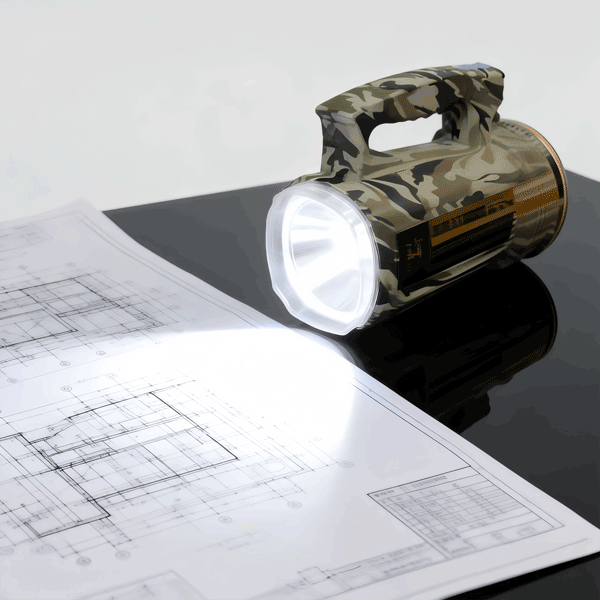 Design and Experience Value: Making Engineering Attributes Instantly Understandable for Clear Procurement Decisions
The ‘trustworthiness’ of tool products stems from intuition: an integrated handle assures users it can be gripped, dropped, and endure prolonged operation; large rounded corners and substantial wall thickness convey durability and protection; the black bezel forms a collision boundary while making lamp head assembly and replacement more intuitive. To minimise post-production service and repair costs, the monolithic structure reduces loosening risks, while standardised components facilitate spare part management and rapid repairs. Should brand differentiation be required, we typically introduce variations in handle cross-section, tactile feedback around the switch area, and detailing on the lamp head’s front frame – all without compromising injection moulding or assembly efficiency.
Design and Experience Value: Making Engineering Attributes Instantly Understandable for Clear Procurement Decisions
The ‘trustworthiness’ of tool products stems from intuition: an integrated handle assures users it can be gripped, dropped, and endure prolonged operation; large rounded corners and substantial wall thickness convey durability and protection; the black bezel forms a collision boundary while making lamp head assembly and replacement more intuitive. To minimise post-production service and repair costs, the monolithic structure reduces loosening risks, while standardised components facilitate spare part management and rapid repairs. Should brand differentiation be required, we typically introduce variations in handle cross-section, tactile feedback around the switch area, and detailing on the lamp head’s front frame – all without compromising injection moulding or assembly efficiency.
Structural and Engineering Logic: Mature ‘Three-Segment’ Architecture for Enhanced Mass Production Stability
We recommend adopting the industry-validated three-segment structure: A. Lamp Head Module (front bezel/transparent lens/reflector cup/LED and heat dissipation components); B. Central main housing (load-bearing structure + integrated handle + wiring/switch mounting points); C. Rear battery compartment (battery box + rear cover, supporting screw, hinge or detachable structures). This architecture offers distinct advantages: clear functional boundaries, natural assembly sequence, manageable post-production maintenance, and the ability to concentrate high precision and aesthetic demands on a limited number of critical components, thereby enhancing overall yield rates.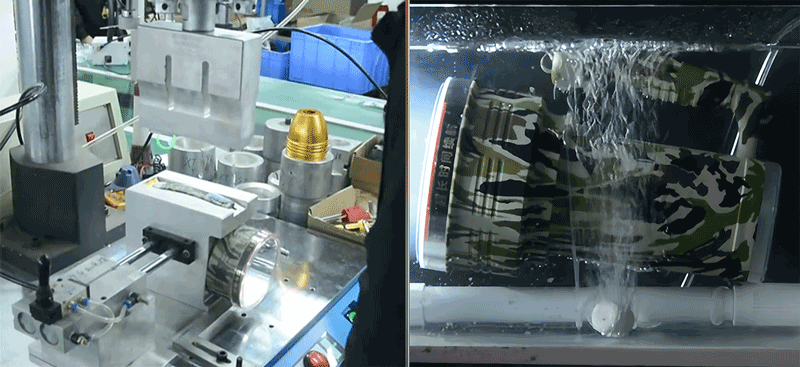
Materials and Manufacturing Processes: A Feasible Solution Centred on Injection-Moulded Plastics
The main housing (yellow) serves as the core structural component. A single injection-moulded part strategy is typically employed, with assembly of multiple parts not recommended to minimise the risk of tolerance stack-up and loosening. A wall thickness of approximately 2.0–2.5mm is advised, achieving a balance between strength and weight through internal hollowing and rib reinforcement. The parting line is advised to run along the longitudinal centreline of the lamp body. Simultaneously, utilise the inner side of the handle as a ‘concealment zone’ to hide parting and ejector marks in inconspicuous areas. The front lamp frame (black bezel) is injection moulded separately and can be secured via internal snap-fit or screw locking. The black material offers greater tolerance for weld lines and facilitates future replacement. The transparent lamp cover should be manufactured via PC injection moulding rather than blow moulding, with a minimum thickness of 2.0mm to enhance impact resistance. The gate location must avoid the front visual centre, whilst controlling shrinkage and optical distortion. Where project timelines are critical, structural prototypes may be produced first to validate assembly and grip ergonomics before proceeding to the final moulding stage. Relevant competencies may be referenced: Industrial Design Services: For the early collaborative definition of structure and appearance Injection moulding services: for matching mass production processes with production capacity Transaction Process: Assisting overseas teams in swiftly aligning milestones and deliverables from prototyping to mass production. Contact our engineering team: for DFM reviews and manufacturability discussionsMass Production and Quality Risks: Three Key Areas We Will Prioritise Monitoring
1) Wall Thickness and Material Accumulation: The base of handles is most prone to material accumulation, leading to shrinkage, internal stresses, and deformation. Therefore, internal hollowing and appropriate rib placement are essential. Based on our experience, we recommend adhering to the strategy of ‘handle solid area ≤ 1.2× wall thickness, internal rib thickness ≤ 0.6T’, with transitions at corners to reduce stress concentration. 2) Centre of Gravity and Handling: Both the lamp head and battery are relatively heavy. The handle must be positioned directly above the centre of gravity; otherwise, prolonged carrying will cause wrist fatigue, and the unit is more prone to twisting damage if dropped. 3) Outdoor Protection: Connectors must be designed to meet dust and water resistance targets, achieving at least IPX4 compliance. The joint between the lamp head and main housing should incorporate a step and sealing groove. The battery compartment cover requires a clear compression path and reliable locking mechanism to prevent field misassembly leading to water ingress and complaints.Suitable Clients/Projects: Primarily for ’Engineering-Driven OEM Mass Production”
This handheld spotlight housing design is well-suited for projects developing emergency lighting, inspection torches, firefighting equipment, or outdoor engineering floodlights. It offers structural stability, high assembly efficiency, and controllable moulding risks, while ensuring consistent quality and traceability during mass production. It is particularly suited for project teams with defined performance metrics (drop resistance, ingress protection ratings, temperature rise/thermal constraints) who are willing to undertake DFM reviews and trial production validation during the early stages.Natural Inquiry Guidance: Confirm feasibility first, then finalise aesthetic details
Should you possess preliminary design or structural drafts, we recommend initiating an engineering feasibility consultation: confirming three-part moulding, handle strength pathways, lens gate placement and optical distortion control, alongside sealing strategies for protective structures. This approach clarifies mould dimensions, cooling cycles, assembly takt times, and yield risks early in project initiation, preventing subsequent mould revisions. Submit your requirements by contacting our engineering team. We will provide manufacturability recommendations and a critical risk list based on your target protection rating, projected annual volume, and assembly method.Ready To Start Your Project?
Tell us about your part, material, quantity, or mold requirements. Our team will review your project and provide a practical manufacturing solution.