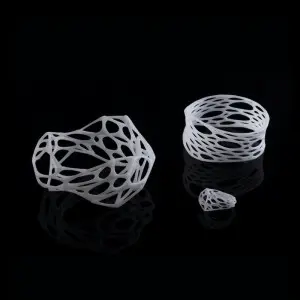
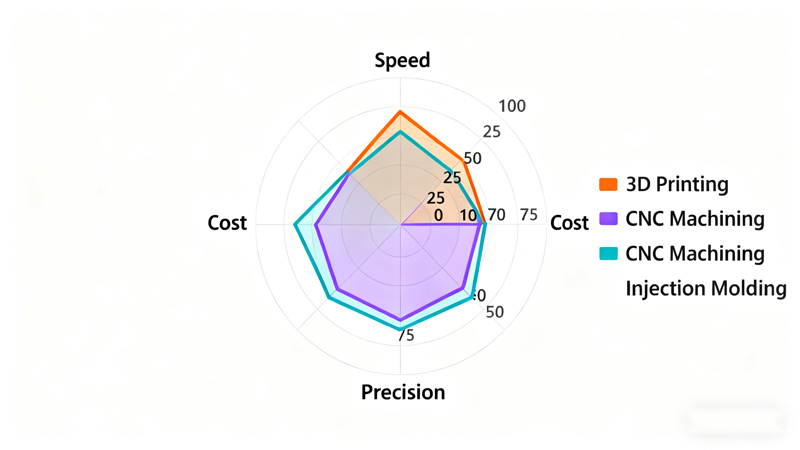
When embarking on the journey of creating a new plastic product, selecting the right plastic prototype manufacturing process is the most critical decision you’ll face. This choice directly impacts your timeline, budget, and the fidelity of your design validation. While 3D printing often comes to mind first for its speed, it’s merely one tool in a broader arsenal. True strategic advantage comes from understanding the strengths and applications of all primary methods: 3D Printing, CNC Machining, and Low-Volume Injection Molding. 3D Printing: The Champion of Speed and Complexity Also known as Additive Manufacturing, 3D printing builds parts layer-by-layer from a digital CAD file, requiring no tooling. This makes it unparalleled for certain early-stage applications.
 FAQ:
- Primary Technologies:
- SLA (Stereolithography): Uses a laser to cure liquid resin, producing parts with very smooth surfaces and high detail, ideal for visual prototypes and master patterns.
- SLS (Selective Laser Sintering): A laser fuses nylon-based powder, creating robust parts that require no support structures, making them excellent for functional components and complex assemblies.
- FDM (Fused Deposition Modeling): The most common and affordable technology, it extrudes a thermoplastic filament. While layer lines are visible, it’s perfect for basic proof-of-concept models and fit checks.
- Best Use Cases: Concept modeling, form and fit verification, parts with intricate internal geometries or undercuts that are challenging for other methods.
- Advantages: The fastest lead time (often 1-3 days), lowest cost for single-unit prototypes, and ultimate design freedom without geometric constraints.
- Limitations: Parts can have anisotropic mechanical properties (weaker in one direction), a stair-stepped surface finish, and limited material options that often do not match production-grade thermoplastics.
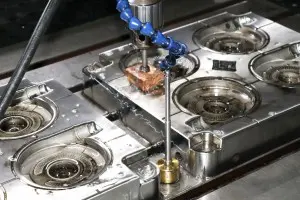
- Best Use Cases: Creating high-strength, functional prototypes that must endure real-world testing; producing parts that require specific engineering-grade material properties; and when tight tolerances and excellent surface finish are paramount.
- Advantages: Superior accuracy and dimensional stability. Parts have homogenous and excellent mechanical properties, identical to those of mass-produced items. It offers the widest selection of real, engineering-grade thermoplastics.
- Limitations: Higher cost per part than 3D printing, especially for complex geometries. There can be geometric restrictions as the cutting tools cannot always reach every internal feature. It also generates material waste.
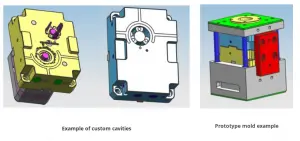
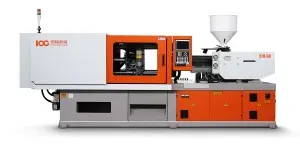
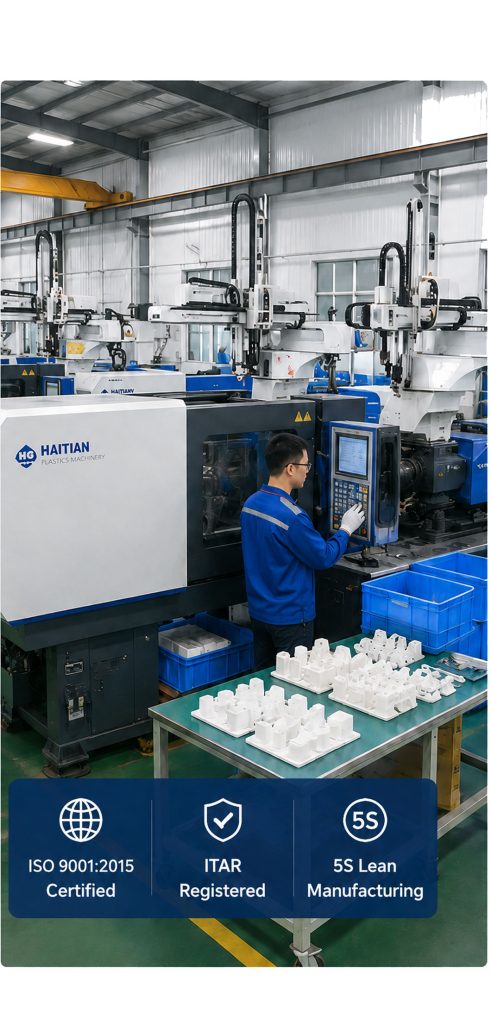
- Best Use Cases: Producing 10 to 10,000+ prototype parts that need to be functionally and cosmetically identical to the final product. It is ideal for pilot runs, market testing, clinical trials, and final design validation before committing to expensive high-volume production tooling.
- Advantages: The lowest cost per part at higher quantities. Parts are true production-equivalents in material, strength, and cosmetic finish. It is the only process that truly validates the manufacturability of your design for injection molding.
- Limitations: Highest initial cost due to mold fabrication and longer lead time (2-4 weeks). Not cost-effective for a single prototype.
FAQ:
- Q: When should I choose CNC machining over 3D printing for a plastic prototype? A: Choose CNC when you need a part for functional testing that requires the strength, durability, or specific thermal/chemical properties of a production-grade plastic. If your prototype must withstand stress or match the final product’s performance, CNC is the superior choice.
- Q: Can 3D printing use the same materials as injection molding? A: Generally, no. 3D printing uses specialized materials like photopolymer resins or filament spools, which have different properties from the pellets used in injection molding. While material science is advancing, the material properties are not directly equivalent.