In plastic prototype manufacturing, the material you choose is not just about color or feel—it’s about performance. The right material ensures your prototype accurately simulates how the final product will behave, from withstanding impact to resisting chemicals or bearing a load. While 3D printing offers a range of proprietary resins and filaments, for prototypes that need to perform like the real thing, you must turn to the engineering-grade thermoplastics used in CNC machining and injection molding. Why Material Selection is a Strategic Decision Choosing the correct material is a critical step in de-risking your product development. A prototype made from the wrong material can lead to false test results, design changes that are not needed, or a failure to identify a critical flaw. The goal is to match the material properties to your product’s end-use environment as closely as possible. A Deep Dive into Common Engineering Thermoplastics for Prototypes
 Consulting with Experts At DTG, our engineers don’t just supply materials; we provide consultancy. We help you navigate the complex landscape of material properties—from tensile strength and heat deflection temperature to biocompatibility and UV stability—to ensure your plastic prototype manufacturing project is built on a foundation of accurate, reliable data. FAQ:
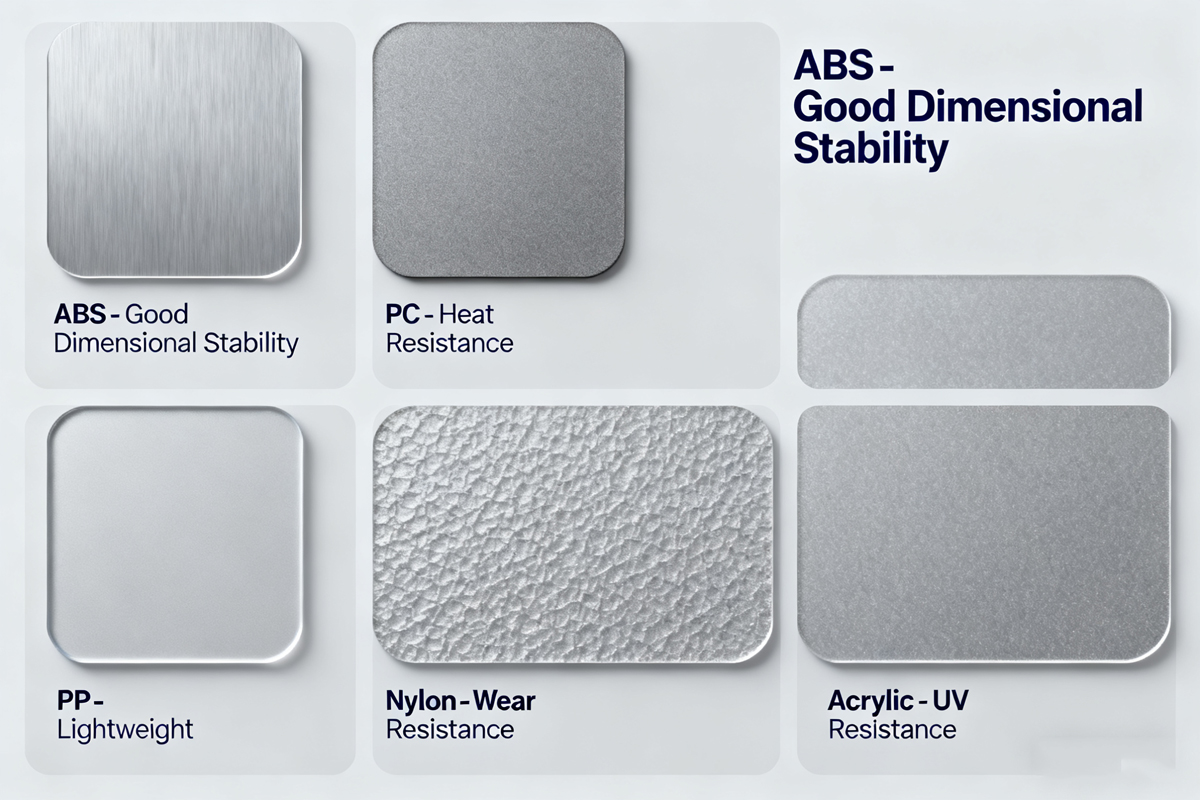
- ABS (Acrylonitrile Butadiene Styrene):
- Properties: An excellent all-rounder known for its good impact strength, rigidity, and toughness. It’s relatively low-cost and easy to machine or mold.
- Prototype Applications: Ideal for consumer electronics housings, automotive interior parts, and functional prototypes that require a balance of strength and aesthetics. It can be easily sanded and painted for a high-quality finish.
- Polycarbonate (PC):
- Properties: Distinguished by its exceptional impact resistance and high transparency. It has good heat resistance and dimensional stability.
- Prototype Applications: Used for prototypes requiring clarity, such as lenses, light guides, and protective shields. Also perfect for high-strength components like crash-resistant parts and medical device housings. It is often blended with ABS (PC-ABS) to enhance heat and impact resistance.
- Polypropylene (PP):
- Properties: Offers excellent chemical resistance and fatigue resistance. It is semi-rigid and can be made into “living hinges” that can withstand repeated bending without breaking.
- Prototype Applications: Perfect for prototyping containers, liquid handling components, laboratory equipment, and any part that features an integral hinge.
- Nylon (Polyamide, PA):
- Properties: A strong, durable, and wear-resistant material with good chemical resistance. It has a low coefficient of friction, making it self-lubricating in some applications.
- Prototype Applications: The go-to material for functional mechanical parts like gears, bearings, bushings, and clips. Its strength and toughness make it suitable for demanding applications.
- Acrylic (PMMA):
- Properties: Provides brilliant optical clarity and light transmission, superior to that of polycarbonate. It is stiff and has good weather resistance but is more brittle.
- Prototype Applications: Used as a lightweight, shatter-resistant alternative to glass for prototypes like light covers, displays, and signage.
- CNC Machining: Allows you to use solid stock of virtually any production-grade thermoplastic, giving you the most accurate representation of the final material’s performance.
- Injection Molding: Uses the exact same plastic pellets (thermoplastic resins) that will be used in mass production. This is the ultimate method for material validation.
- 3D Printing: Material choices are process-specific (SLA resins, SLS Nylon, FDM filaments). While they can simulate some properties, they are not directly equivalent to their injection molding counterparts.
Consulting with Experts At DTG, our engineers don’t just supply materials; we provide consultancy. We help you navigate the complex landscape of material properties—from tensile strength and heat deflection temperature to biocompatibility and UV stability—to ensure your plastic prototype manufacturing project is built on a foundation of accurate, reliable data. FAQ:
- Q: Can I get a transparent or clear plastic prototype? A: Absolutely. For CNC machining, Polycarbonate (PC) and Acrylic (PMMA) are excellent choices for clear parts. For 3D printing, certain SLA resins can produce transparent parts, though they may not achieve the optical clarity of machined or molded materials.
- Q: How do I choose a material for a part that will be used outdoors? A: You would need a material with good UV and weather resistance. ABS can be suitable if painted, but materials like ASA (similar to ABS but with superior UV stability) or Polycarbonate are often better choices for unpainted outdoor applications.