
111-Two Shot Sports Water Bottle Cap | Sports Water Bottle CapManufacturer
Two-Shot Sports Bottle Cap Manufacturing Overview
Our factory supports custom mold development and precision injection molding from DFM analysis through tooling, mold trials and production. For bottle-cap programs, our engineering focus is on process repeatability, material compatibility, functional interfaces and production stability rather than cosmetic appearance alone.
The illustrated component is our two-shot molded sports bottle lid using a rigid PP structural body and a soft TPE overmold. The PP section forcms the primary housing, assembly interfaces, hinge-related geometry and locking features. The TPE section is applied locally to create an anti-slip gripping zone and integrated raised branding.
A properly engineered PP and TPE Sports Bottle Cap can combine structural
performance and tactile functionality within one coordinated molding process. Compared with manufacturing a rigid cap and subsequently installing or bonding a separate soft component, the two-shot approach can reduce handling steps and improve repeatability between the hard and soft sections.
As a Sports Water Bottle Cap Manufacturer and custom mold supplier, we evaluate product geometry, resin behavior, molding sequence, gate position, cooling requirements and overmold retention before tooling release.
Related manufacturing capability:: our Precision Plastic Injection Molding
Services .

Common Production Issues & Engineering Solutions
Our two-material lid requires coordinated control of mold construction, material selection and processing conditions. The following issues are typical considerations during tooling qualification and serial production.
| Common Production Issue | Possible Cause | Recommended Engineering Approach |
|---|---|---|
| TPE edge lifting or local delamination | Material incompatibility, insufficient mechanical retention or unsuitable interface geometry | We recommend verifying PP/TPE grade compatibility and optimizing grooves, through-holes, undercuts or other mechanical interlock features where required |
| Flash around the TPE boundary | Insufficient shut-off accuracy, mold mismatch, excessive second-shot pressure or local steel deflection | We recommend reviewing shut-off geometry, mold rigidity and second-shot process parameters before production approval |
| Incomplete filling in soft-grip areas | Long TPE flow path, inadequate venting, restrictive gate design or unsuitable processing conditions | We recommend optimizing gate dimensions and flow direction, improving venting and establishing a validated molding window during mold trials |
| Burn marks or trapped gas | Air accumulation at end-of-fill locations | We recommend adding or relocating venting features and considering enhanced venting solutions for enclosed or thin-wall overmold regions |
| Cap warpage or dimensional variation | Non-uniform PP wall thickness, cooling imbalance or uneven shrinkage | We recommend optimizing structural wall thickness and cooling layout and verifying critical dimensions after complete thermal stabilization |
| Visible weld lines | Unfavorable gate location or material flow-front meeting position | We recommend adjusting gate strategy and flow path to move weld lines away from critical cosmetic or functional regions where possible |
| Unstable second-shot positioning | Transfer, rotary platen, rotary core or index-plate positioning deviation | We recommend verifying mechanical repeatability between first-shot and second-shot positions during mold qualification |
| Leakage after assembly | Deformed sealing interface, dimensional stack-up, flash or mismatch with mating components | We recommend defining sealing-critical dimensions during DFM and validating assembled parts using leakage or air-tightness testing |
Ready To Start Your Project?
Tell us about your part, material, quantity, or mold requirements. Our team will review your project and provide a practical manufacturing solution.
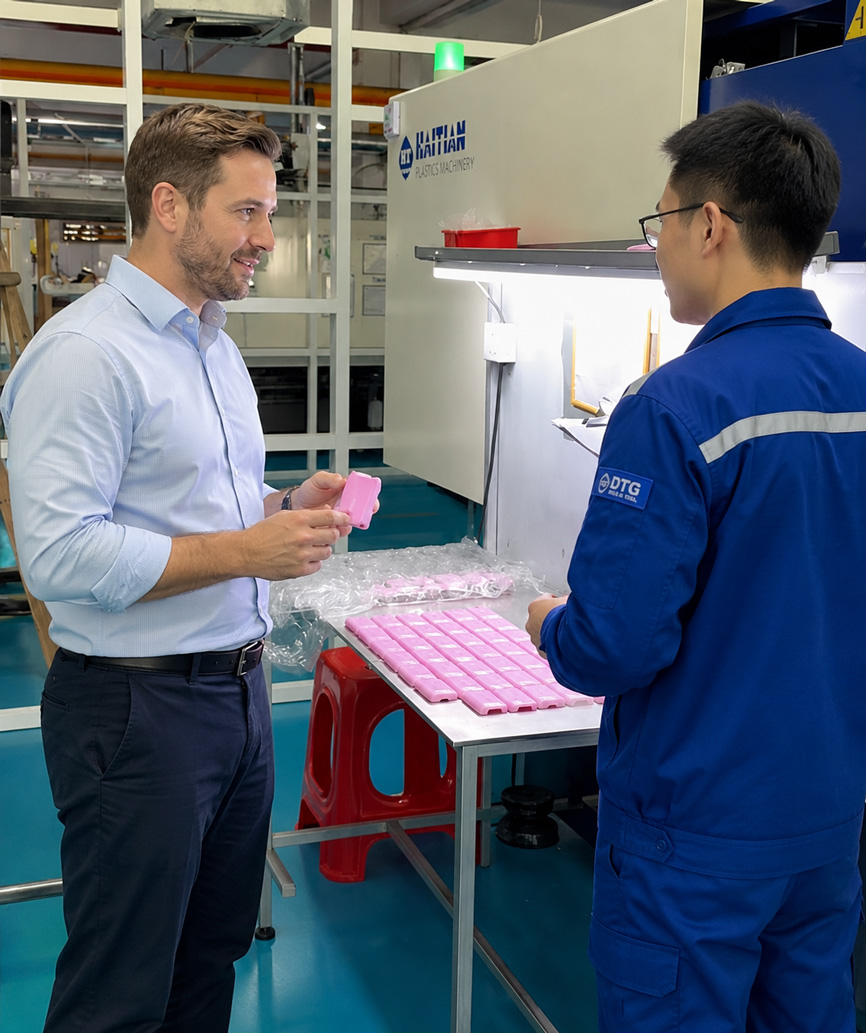
Why Choose DTG for Custom Injection Molding Services?
Combining engineering expertise, advanced manufacturing, and rigorous quality control to support your project from concept to production.
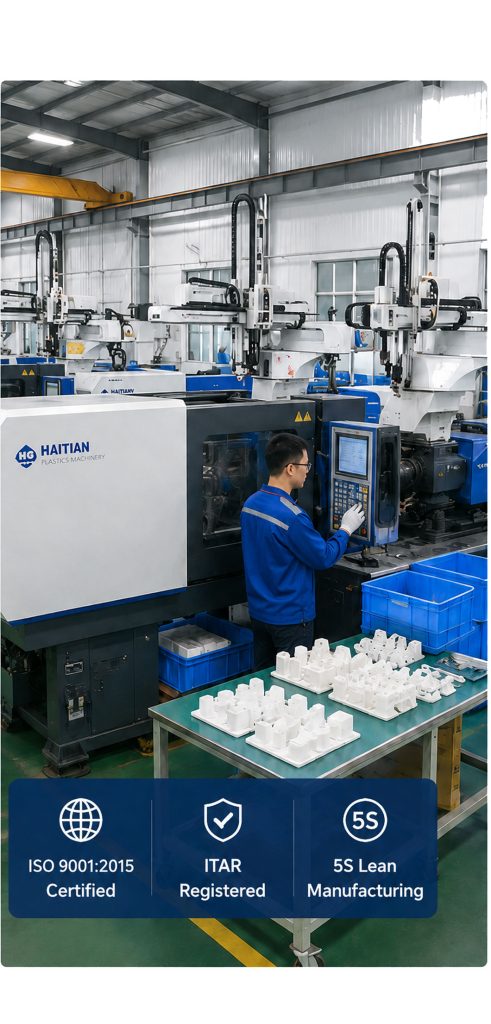

ISO 9001:2015 Certified
Our ISO 9001:2015 quality management system supports consistent processes from material inspection and molding to final inspection and shipment, helping ensure reliable and repeatable quality throughout production.

Advanced Manufacturing Equipment
Our modern injection molding equipment supports a wide range of part sizes, materials, and production volumes. Process control and inspection equipment help us maintain consistent quality from initial samples through full-scale production.

Engineering & DFM Support
Our engineering team provides DFM feedback, material selection support, and mold design recommendations before production, helping identify potential manufacturing issues early and reduce unnecessary tooling changes, delays, and costs.

Fast Lead Times
With coordinated engineering, tooling, and injection molding production, we streamline each stage from DFM review to mold trials and production, helping customers shorten development cycles and keep projects on schedule.

Injection Molding Expertise
Our team supports injection molding projects with complex geometries, tight tolerances, demanding cosmetic requirements, and a wide range of engineering plastics—from prototype development to repeat production.

Responsive Project Support
From quotation and DFM review through tooling, sampling, production, and delivery, our team keeps communication clear and responsive. Engineering questions, design changes, and production updates are handled quickly to keep your project moving.