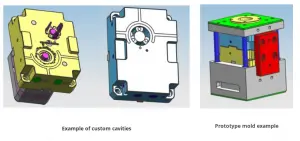
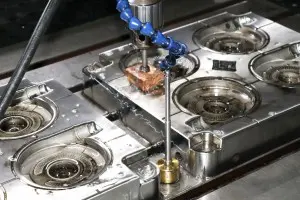
With the wide application of plastic products, the public has higher and higher requirements for the appearance quality of plastic products, so the surface polishing quality of the plastic mold cavity should also be improved accordingly, especially the mold surface roughness of the mirror surface and high-gloss high-brightness surface. The requirements are higher, and therefore the requirements for polishing are also higher. Polishing not only increases the beauty of the workpiece, but also improves the corrosion resistance and wear resistance of the material surface, and can also facilitate subsequent injection molding, such as making plastic products easier to demould and reducing production injection molding cycles. At present, the commonly used polishing methods are as follows:
(1) Mechanical polishing
Mechanical polishing is a polishing method in which a smooth surface is obtained by cutting and plastic deformation of the surface of the material to remove the polished convex part. Generally, whetstone strips, wool wheels, sandpaper, etc. are used. Using auxiliary tools such as turntables, ultra-fine grinding and polishing methods can be used for those with high surface quality requirements. Ultra-precision grinding and polishing is a special abrasive tool, which is pressed on the surface of the workpiece to be machined in the grinding and polishing liquid containing abrasive, and rotates at high speed. Using this technology, the surface roughness of Ra0.008μm can be achieved, which is the highest among various polishing methods. Optical lens molds often use this method.
(2) Ultrasonic polishing
The workpiece is placed in the abrasive suspension and placed in the ultrasonic field together, and the abrasive is ground and polished on the surface of the workpiece by the oscillation of the ultrasonic wave. The macroscopic force of ultrasonic processing is small, and it will not cause deformation of the workpiece, but it is difficult to make and install the tooling. Ultrasonic machining can be combined with chemical or electrochemical methods. On the basis of solution corrosion and electrolysis, ultrasonic vibration is applied to stir the solution, so that the dissolved products on the surface of the workpiece are detached, and the corrosion or electrolyte near the surface is uniform; the cavitation effect of ultrasonic waves in the liquid can also inhibit the corrosion process, which is conducive to surface brightening.
(3) Fluid polishing
Fluid polishing relies on high-speed flowing liquid and the abrasive particles carried by it to scour the surface of the workpiece to achieve the purpose of polishing. Commonly used methods are: abrasive jet machining, liquid jet machining, hydrodynamic grinding, etc. Hydrodynamic grinding is driven by hydraulic pressure, so that the liquid medium carrying abrasive particles flows reciprocatingly across the surface of the workpiece at high speed. The medium is mainly made of special compounds (polymer-like substances) with good flowability under lower pressure and mixed with abrasives, and the abrasives can be silicon carbide powder.
(4) Magnetic grinding and polishing
Magnetic grinding and polishing is to use magnetic abrasives to form abrasive brushes under the action of a magnetic field to grind workpieces. This method has high processing efficiency, good quality, easy control of processing conditions and good working conditions. With suitable abrasives, the surface roughness can reach Ra0.1μm.
The polishing in plastic mold processing is very different from the surface polishing required in other industries. Strictly speaking, the polishing of the mold should be called mirror processing. It not only has high requirements for polishing itself but also high standards for surface flatness, smoothness and geometric accuracy. Surface polishing is generally only required to obtain a bright surface.
The standard of mirror processing is divided into four grades: AO=Ra0.008μm, A1=Ra0.016μm, A3=Ra0.032μm, A4=Ra0.063μm, it is difficult to precisely control the geometric accuracy of parts due to electrolytic polishing, fluid polishing and other methods However, the surface quality of chemical polishing, ultrasonic polishing, magnetic grinding and polishing methods cannot meet the requirements, so the mirror surface processing of precision molds is still dominated by mechanical polishing.