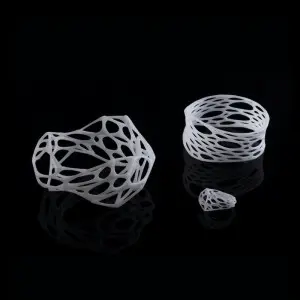
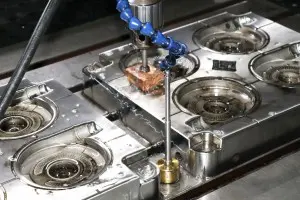
Originally created as a method of rapid prototyping, 3D printing, also known as additive manufacturing, has evolved into a true manufacturing process. 3D printers enable engineers and companies to produce both prototype and end-use products at the same time, offering significant advantages over traditional manufacturing processes. These advantages include enabling mass customisation, increasing design freedom, allowing for reduced assembly and can be used as a cost effective process for small batch production. So what are the differences between 3D printing technology and the current established traditional CNC processes? 1 – Differences in materials The main materials used for 3D printing are liquid resin (SLA), nylon powder (SLS), metal powder (SLM) and wire (FDM). Liquid resins, nylon powders and metal powders make up the vast majority of the market for industrial 3D printing. The materials used for CNC machining are all one piece of sheet metal, measured by the length, width, height and wear of the part, and then cut to the corresponding size for processing, CNC machining materials selection than 3D printing, general hardware and plastic sheet metal can be CNC machined, and the density of the formed parts is better than 3D printing. 2 – Differences in parts due to moulding principles 3D printing is the process of cutting a model into N layers / N points and then stacking them up in sequence, layer by layer / bit by bit, just like building blocks. 3D printing is therefore effective in machining complex structural parts such as skeletonised parts, whereas CNC machining of skeletonised parts is difficult to achieve. CNC machining is subtractive manufacturing, where various tools running at high speed cut out the required parts according to a programmed toolpath. Therefore, CNC machining can only be processed with a certain degree of curvature of the rounded corners, the outer right angle CNC machining is no problem, but can not be directly machined out of the inner right angle, to be achieved through wire cutting / EDM and other processes. In addition, for curved surfaces, CNC machining of curved surfaces is time consuming and can easily leave visible lines on the part if the programming and operating personnel are not experienced enough. For parts with internal right angles or more curved areas, 3D printing is not as difficult to machine. 3 – Differences in operating software Most of the slicing software for 3D printing is simple to operate and is currently optimised to be very simple and support can be generated automatically, which is why 3D printing can be popularised to individual users. CNC programming software is much more complex and requires professionals to operate it, plus a CNC operator to operate the CNC machine. 4 – CNC programming operation page A part can have many CNC machining options and is very complex to program. 3D printing, on the other hand, is relatively simple as the placement of the part has a small impact on the processing time and consumables. 5 – Differences in post-processing There are few post-processing options for 3D printed parts, generally sanding, blasting, deburring, dyeing, etc. In addition to sanding, oil blasting and deburring, there are also electroplating, silk-screening, pad printing, metal oxidation, laser engraving, sandblasting and so on. In summary, CNC machining and 3D printing have their own advantages and disadvantages. Choosing the right machining process is even more important.
Similar Posts
What Is The Prototyping Mold ?
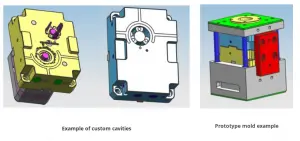
About Prototype Mould Prototype mould is generally used for testing the new design before mass production. In order to save the cost, the prototype mould have to be cheap. And mould life could be short, as low as several hundreds shots. Material – Many injection molder prefer to use aluminium 7075-T6 Mould Life – Maybe…
What is hot runner mold ?
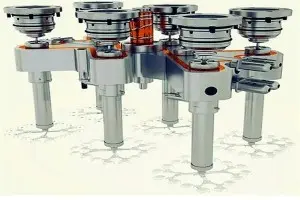
Hot runner mold is a common technology used to make the large size part like the 70 inch TV bezel, or high cosmetic appearance part. And it is also exploited when the raw material is expensive. Hot runner, as the name means, the plastic material is staying molten on the runner system, called manifold, and is…
Introduction Of Injection Molding Machine
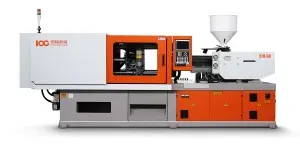
About Injection molding machine Mould or tooling is the key point to produce the high precision plastic molded part. But the mold would not move by itself, and should be mounted on the injection molding machine or called press to form the product. Injection molding machine is rated by tonnage or force, the smallest as…
Things Should Be Known When Design Plastic Parts
You have a very good idea for a new product, but after completing the drawing, your supplier tells you that this part can not be injection molded. Let’s see what we should notice when designing a new plastic part. Wall thickness – Maybe all plastic injection molding engineers would suggest to make the wall thickness as…
3D Printing Technology
A prototype can be used as an earlier sample, model, or release of a product built to test a concept or process. … A prototype is generally used to evaluate a new design to enhance precision by system analysts and users. Prototyping serves to provide specifications for a real, working system rather than a theoretical one….
Edm Technology
Electrical Discharge Machining (or EDM) is a machining method used to machine any conductive materials including hard metals which are difficult to machine with traditional techniques. … The EDM cutting tool is guided along the desired path very close to the work but it does not touch the piece. Electrical Discharge Machining, which can be divided into three common…