Custom Plastic Parts for Home Appliances and Electronics

Key Benefits Buyers Care About
Engineering Risk Reduction
DFM analysis reviews wall thickness, ribs, undercuts, draft angles, gate locations, cooling, and venting before mold construction.
Controlled Tooling Investment
Mold steel, cavity count, runner type, and mold life target are selected according to production volume, resin, appearance, and cost requirements.
Reliable Production Support
Custom Plastic Parts can be supported from prototype review to mold testing, modification, mass production, finishing, and assembly.
Application Scenarios for Plastic Parts for Home Appliances
Complete Development and Manufacturing Workflow
| Service Stage | Core Activities |
|---|---|
| Product Structure Evaluation | Feasibility review of 3D and 2D drawings, including wall thickness, ribs, undercuts, and manufacturability. |
| DFM Analysis | Formal injection molding-oriented design optimization and early manufacturing risk identification. |
| Mold Design | Full 3D mold design, including parting line, gating, cooling, and ejection systems. |
| Mold Manufacturing | CNC machining, EDM, grinding, polishing, and complete mold fabrication. |
| Injection Molding | Mass production using injection molding machines. |
| Surface Finishing | Painting, silk-screen printing, pad printing, electroplating, mold texturing, and polishing. |
| Product Assembly | Multi-component assembly according to customer requirements. |
Materials and Manufacturing Process
Component Categories
| Category | Typical Requirements |
|---|---|
| Cosmetic Components | No visible sink marks, flow marks, weld lines, or silver streaks; high color consistency; uniform gloss. |
| Functional Components | Dimensional accuracy, assembly clearance control, tactile feel, travel distance, and actuation force. |
| Structural Components | Mechanical strength, fatigue resistance, creep resistance, and dimensional stability. |
| Transparent Components | High light transmission, clean surface finish, and no bubbles, contamination, or flow marks. |
| Material | Key Characteristics |
|---|---|
| PC | High transparency and excellent impact resistance. |
| PMMA | High surface hardness and light transmission up to 92%. |
| PA and Glass-Fiber-Reinforced PC | Used where load, strength, and dimensional stability are important. |
Mold Engineering Capabilities for OEM Plastic Components for Household Appliances
| Mold Steel | Hardness | Key Characteristics | Typical Applications | Reference Mold Life |
|---|---|---|---|---|
| P20 | 28–32 HRC | Pre-hardened, good machinability, cost-effective | General appliance housings and structural parts | 300,000–500,000 shots |
| 718 / 718H | 33–38 HRC | Improved toughness and fatigue resistance | Appliance housings and automotive interior parts | 500,000–800,000 shots |
| NAK80 | 37–43 HRC | Excellent mirror polishing, no heat treatment required | Transparent parts, LED covers, cosmetic components | Medium to high volume |
| S136 | 48–52 HRC | Stainless steel, corrosion resistance, mirror finish | PVC, POM, optical and transparent applications | Long-life production |
| H13 | 48–52 HRC | Thermal fatigue resistance and high-temperature stability | PC, PEEK, and engineering plastics | >500,000 shots |
Mold Structure, Cavity, Runner, and Life Design
Selection Guidelines
| Application | Recommended Configuration |
|---|---|
| Transparent PC light cover | NAK80 cavity + 718 core |
| High-volume ABS housing | 718 cavity + P20 core |
| PVC molded parts | S136 required for corrosion resistance |
Mold Life Design
| Mold Life Rating | Typical Application |
|---|---|
| 100,000 cycles | Pilot production and short-term projects |
| 300,000 cycles | Standard production programs |
| 500,000 cycles | Long-term volume production |
| 1,000,000 cycles | High-volume core products |
| Cavity Configuration | Typical Applications | Advantages | Design Considerations |
|---|---|---|---|
| Single Cavity | Large parts, mold trials, low-volume production | Lower tooling cost and simpler design | Lower productivity |
| Two Cavities | Medium-sized parts, moderate demand | Balanced cost and productivity | Filling balance required |
| Four Cavities | Small to medium parts, higher volume | Improved productivity | Runner balancing is critical |
| Eight or Sixteen Cavities | Buttons, connectors, and small parts | Lowest piece-part cost | Higher mold complexity and tooling cost |
Common Production Issues and Solutions
| Issue | Typical Cause | Engineering Response |
|---|---|---|
| Sink marks on visible surfaces | Uneven wall thickness, thick ribs, or improper packing | Optimize wall thickness, rib design, gate position, packing pressure, and mold cooling. |
| Weld lines or flow marks | Material flow separation or unsuitable gate layout | Review gate location, flow path, mold temperature, injection speed, and venting design. |
| Warpage or assembly mismatch | Non-uniform cooling, internal stress, or insufficient structural balance | Improve cooling layout, adjust wall distribution, and control critical dimensions by precision machining. |
| Bubbles or contamination in transparent parts | Moisture, poor venting, or unstable processing conditions | Control drying, barrel temperature, mold temperature, injection speed, and cavity surface polishing. |
Engineering Solution and Design Considerations
From an engineering perspective, the main challenge is not only making the part shape, but also controlling how the resin flows, cools, shrinks, and ejects from the mold. During DFM review, DTG TECH CO., LTD. evaluates wall thickness, draft angle, undercut structures, ribs, gate location, cooling, and venting.
In practice, this helps reduce molding defects, simplify assembly, and align tooling investment with the expected production volume for Custom Injection Molded Plastic Parts.
| Design Element | Recommended Guideline |
|---|---|
| Wall Thickness | Typically 1.5–3.5 mm with uniform distribution |
| Draft Angle | Typically 1–3° for reliable ejection |
| Undercuts | Evaluate need for sliders or lifters |
| Gate Location | Position away from cosmetic surfaces |
| Cooling Design | Uniform cooling to reduce warpage and internal stress |
| Venting Design | Prevent gas traps, burn marks, and short shots |
Quality Control and Validation
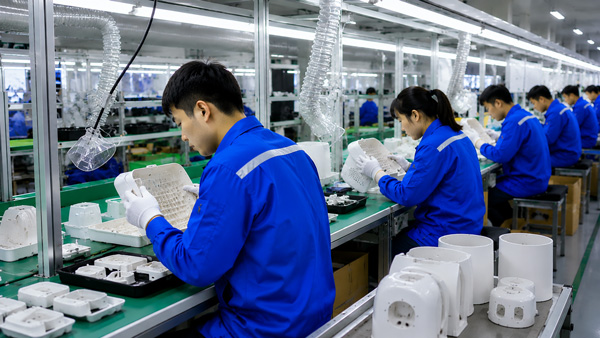
Precision assurance focuses on critical holes, slots, parting surfaces, cavity surfaces, core surfaces, and assembly features. High-precision CNC machining, EDM, and grinding are used to minimize cumulative setup error and maintain dimensional consistency.
- EDM dimensional accuracy: ±1–2 μm, surface finish up to Ra 0.1 μm
- Wire EDM dimensional accuracy: ±1 μm
- Precision grinding flatness: ≤1 μm/100 mm
- CMM inspection measurement accuracy: up to ±0.7–1 μm
- Process capability target: CPK ≥ 1.33
- Assembly gap control target: ±0.05 mm
- Minimal visible parting line on cosmetic surfaces
Project Input Requirements
FAQ
Can you manufacture Plastic Parts for Home Appliances from drawings or samples?
Yes. Projects can start from 3D CAD files, 2D drawings, physical samples, or product photos with basic dimensions. A structure review and DFM analysis are recommended before mold construction.
How do you control cosmetic surface defects?
Cosmetic results depend on cavity surface finish, gate location, wall thickness, material flow, venting, and processing parameters. High-polish or textured cavity surfaces may be selected according to appearance requirements.
What mold steel should be used for a custom plastic housing for electronic products?
The choice depends on part appearance, resin, volume, corrosion risk, and expected mold life. For example, NAK80 is commonly used for transparent and cosmetic components, while 718 and P20 are common for appliance housings.
Can one supplier handle mold making, molding, finishing, and assembly?
DTG TECH CO., LTD. supports mold design, DFM review, prototyping, mold testing, injection molding, surface finishing, product assembly, and quality control for customized production projects.
Related Products or Blog Templates

Engineering Summary for Custom Plastic Parts
For appliance and consumer electronics projects, the success of molded components depends on early design feasibility review, material selection, mold structure, and process control. These factors directly affect appearance, dimensional stability, assembly accuracy, and long-term production cost.
For Custom Injection Molded Plastic Parts, buyers should review cavity configuration, runner system, steel selection, surface finishing requirements, and inspection criteria before tooling starts. This is especially important for a plastic enclosure for electronic products where both cosmetic quality and assembly fit matter.
DTG TECH CO., LTD. supports engineering review, mold design, mold testing, mass production, and quality control for Home Appliance Plastic Parts, helping purchasing and engineering teams balance design feasibility, cost control, stable delivery, and reliable production.
Ready To Start Your Project?
Tell us about your part, material, quantity, or mold requirements. Our team will review your project and provide a practical manufacturing solution.